OSHA Training
Financial risks of OSHA non-compliance
Avoiding OSHA fines and penalties

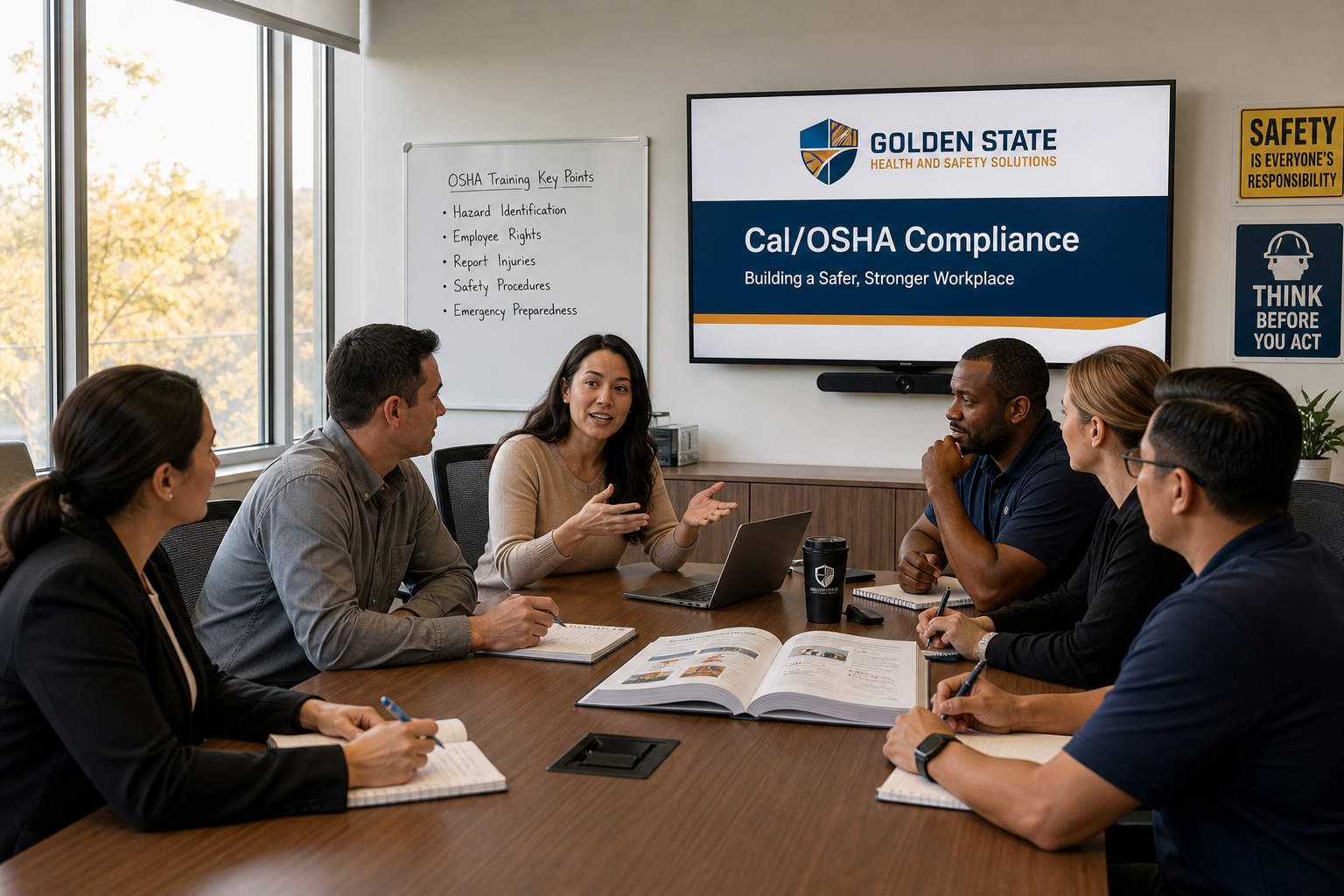
Cal/OSHA mandates that California employers train new hires on workplace-specific hazards under Title 8 regulations before they begin unsupervised work, covering emergency procedures, hazard communication, and equipment use tied to the Injury and Illness Prevention Program. California Safety Training & OSHA Compliance helps HR managers. Safety coordinators statewide document this training and close IIPP compliance gaps quickly.
Cal/OSHA requires training based on specific work activities employees perform at your workplace.
Training requirements appear in Title 8, Division 1, Chapter 4 of California Code of Regulations.
Construction Safety Orders (Subchapter 4) and General Industry Safety Orders (Subchapter 7) contain mandatory training standards.
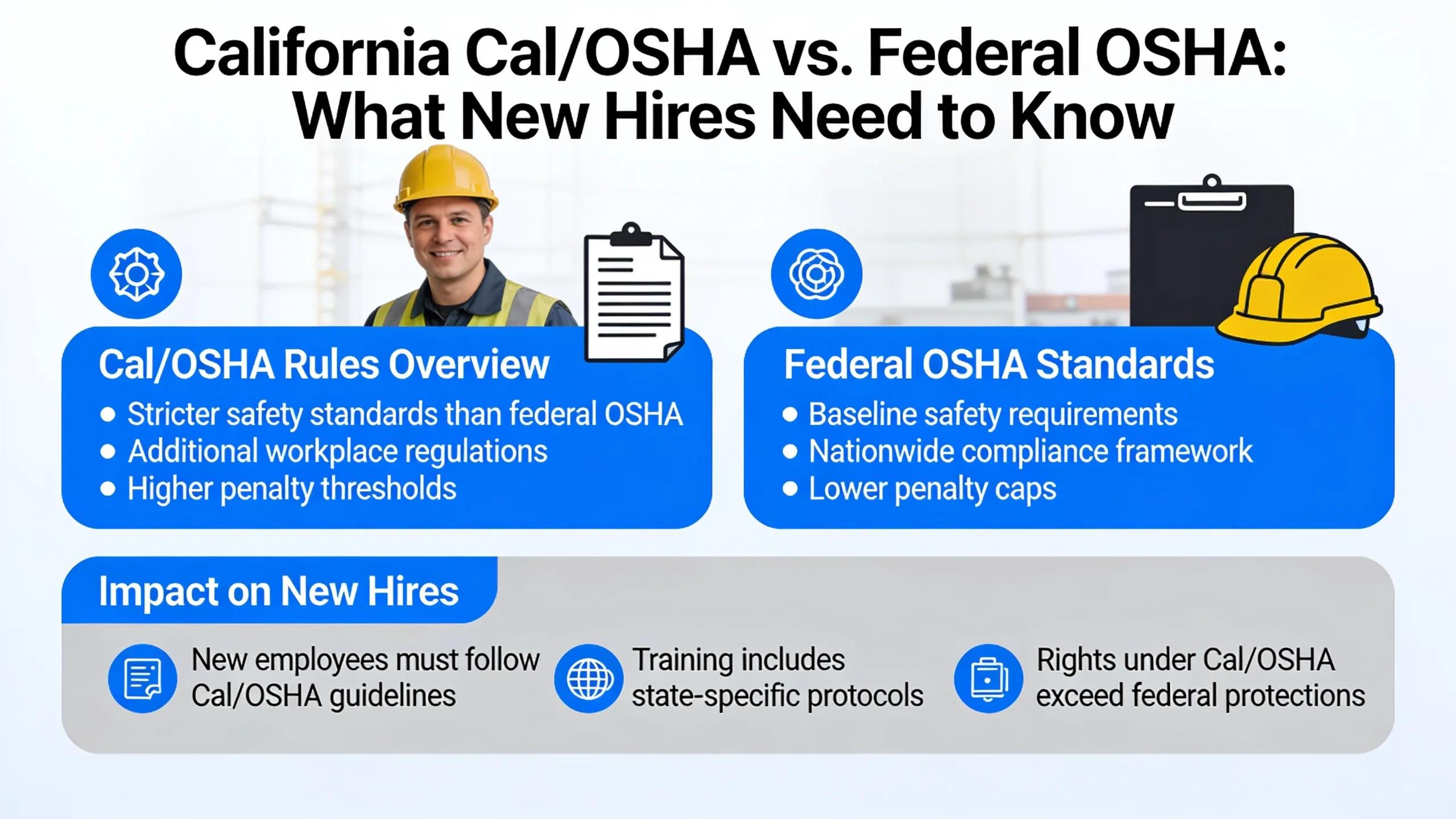
Employers must comply with both Federal OSHA regulations and California's occupational health and safety rules.
New hire safety training California programs cover both federal OSHA standards and California's own, often stricter, Cal/OSHA rules. cite-1 Skipping either layer leaves a business exposed to citations, injury claims, and costly litigation. Golden State-based safety consultants build orientation content around this dual requirement, not a generic federal checklist.
Before onboarding begins, employers need a written IIPP training requirement program in place. California law treats the Injury and Illness Prevention Program as the foundation for all subsequent employee instruction. Once that document exists, a compliant new hire safety orientation typically follows these steps:
Review the company's written IIPP and explain how it applies to the new employee's specific role.
Cover hazard communication rules unique to the worksite, referencing California's state-specific standards.
Walk through emergency procedures, including evacuation routes and injury-reporting protocols.
Document completion with signed acknowledgment forms for the employer's compliance file.
Yes. Cal/OSHA new employee training is mandatory because California's State Plan covers nearly all private-sector employers, plus state and local government agencies. Very few businesses qualify for exceptions, so most California employers carry this obligation from day one of hiring.
Businesses that skip proper orientation put employees at greater risk and expose the company to financial and legal fallout. Consistent, documented training protects workers while shielding the business from penalties and potential lawsuits tied to preventable workplace incidents.
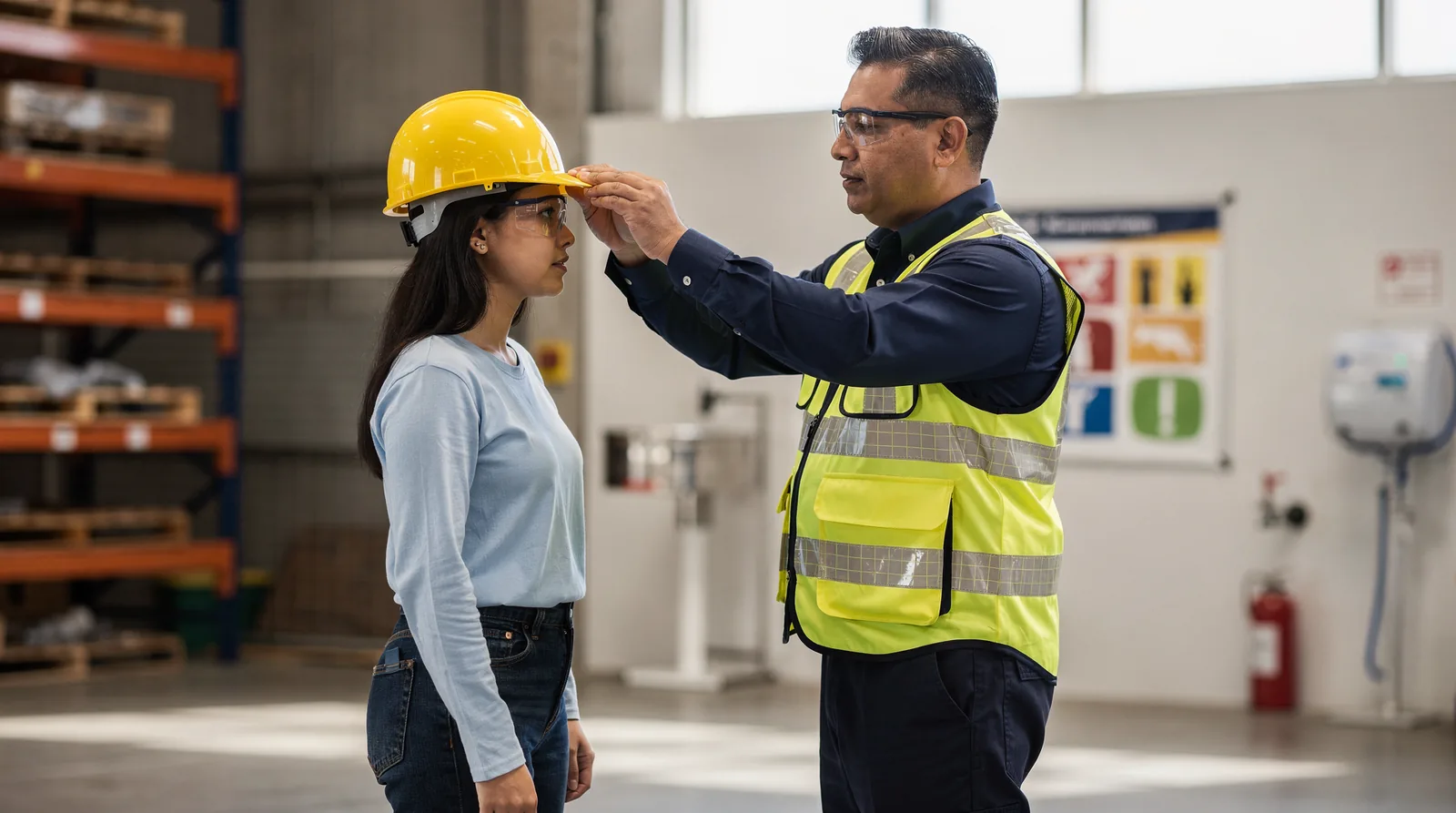
No single checklist covers every California business. Cal/OSHA new employee training topics depend entirely on the actual tasks each worker performs, not a generic template pulled from an outdated binder. A warehouse forklift operator in Fresno needs different instruction than an office administrator in San Diego, even though both fall under the same employer's Injury and Illness Prevention Program.
Title 8 of the California Code of Regulations spells out these obligations across two major sections: the Construction Safety Orders (Subchapter 4) and the General Industry Safety Orders (Subchapter 7). HR teams building an IIPP training requirement checklist should treat both sections as their reference point. Job duties often cross into hazard categories employers don't expect. Cal/OSHA groups these instruction mandates by topic, giving safety coordinators a practical starting point for matching duties to required subjects rather than guessing.
Common categories include hazard communication, emergency procedures, equipment-specific operation, and personal protective equipment use. The exact mix shifts based on industry and role. A new hire safety orientation for a construction crew looks nothing like one for a retail staff.
No. California's regulations are frequently more detailed and demanding than federal standards. Title 8 references were updated as recently as May 2023. Employers relying on older printed guides risk missing revised language.
California employers with multiple locations, from Sacramento to Long Beach, benefit from a structured review process for matching new hire training to Cal/OSHA requirements:
Identify every task category employees actually perform.
Cross-reference those tasks against Subchapter 4 and Subchapter 7 topic lists.
Confirm current citations against the latest Title 8 update.
Document training completion within the IIPP record.
California Safety Training & OSHA Compliance guides employers statewide through this exact matching process, ships training materials to job sites, and travels to California worksites for onboarding sessions.
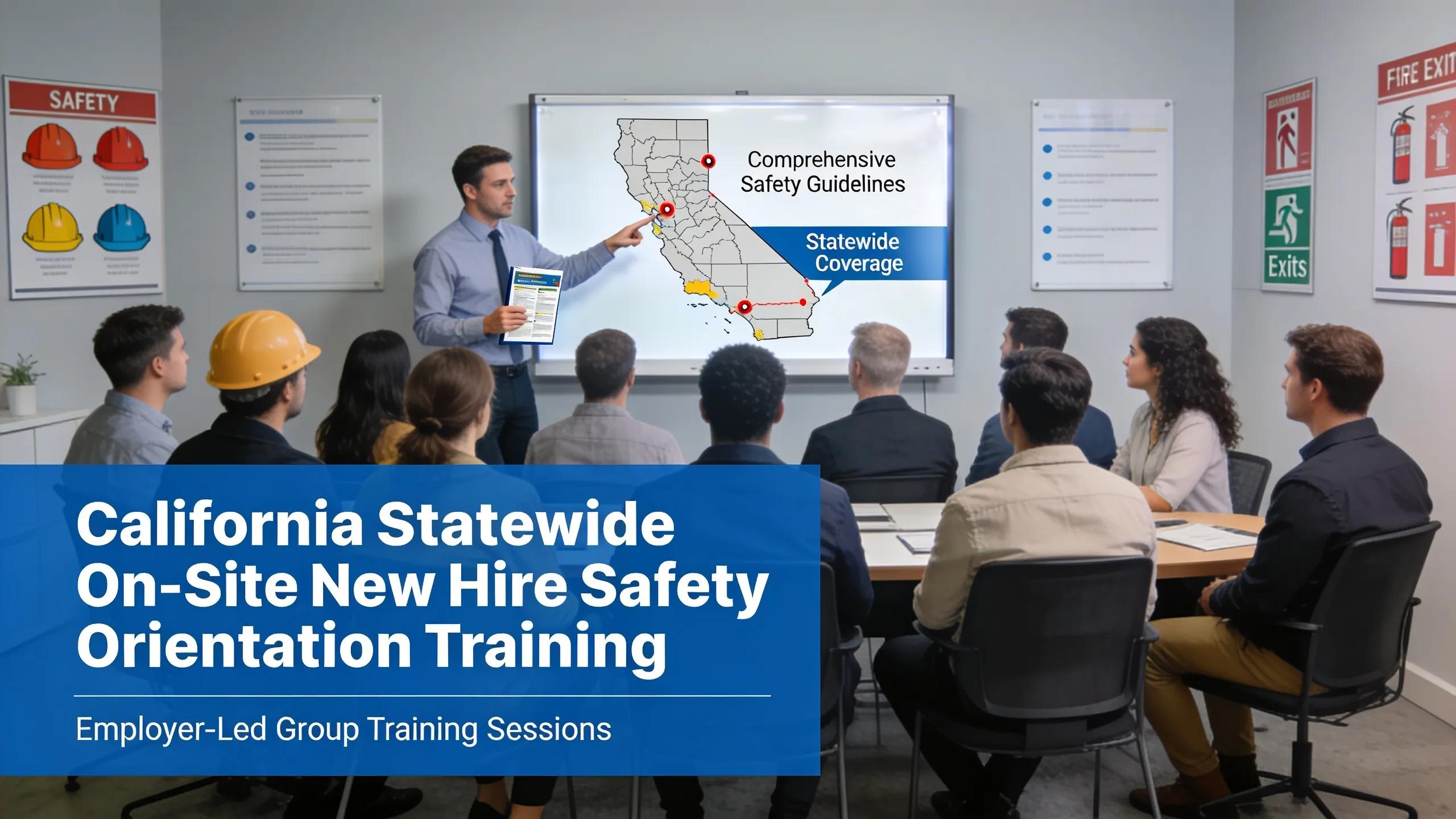
Compliant orientation training requires structured, on-site delivery that meets Cal/OSHA standards from an employee's first day. California employers achieve this by following a clear sequence rather than improvising a checklist during a busy onboarding week.
Prerequisites: Before scheduling any session, HR teams need a current IIPP training requirement review, a list of hazards specific to the job role, and a designated point of contact for Cal/OSHA questions.
Audit onboarding gaps. Compare current new-hire materials against the written Injury and Illness Prevention Program to identify missing topics.
Select a delivery format. On-site group training is available statewide, letting California employers run new hire safety training California sessions without sending staff off-site.
Confirm language needs. Training runs in English and Spanish, supporting Cal/OSHA new employee training for multilingual crews.
Lock in scheduling. Early morning, evening, and weekend options exist so onboarding timelines stay intact without halting daily operations.
Document completion. Retain sign-in sheets and topic outlines to prove new hire safety orientation compliance during an audit.
A compliant orientation covers hazard recognition, emergency procedures, and job-specific safety rules tied directly to the IIPP. It also includes reporting protocols so new employees know exactly who to notify when a hazard appears.
Workplace safety consulting support helps HR teams structure onboarding around actual regulatory obligations instead of guesswork. This guidance covers OSHA compliance support, emergency preparedness planning, and program documentation, giving safety coordinators a reliable resource beyond the classroom session itself.
Small and mid-size employers across California benefit most from this structured approach. Skipping steps or relying on generic templates leaves gaps that surface during an inspection, not before one.
Documentation should record the specific Title 8 section covered, the date, the trainer, and proof the employee understood the material. California employers who rely only on a generic checklist risk gaps that surface during a Cal/OSHA audit. Cal/OSHA's published training topic list serves as a guide only; it is not a substitute for the actual regulatory text. Records built on the summary alone leave employers exposed if an inspector asks for the exact standard behind a training session.
Sound documentation practice follows a consistent sequence:
Identify which Title 8 sections apply to the new hire's job duties.
Confirm current wording of each requirement using the full Title 8 regulations at the Department of Industrial Relations website.
Log the training date, topics covered, trainer name, and citation number.
Collect a signed acknowledgment from the employee.
File records where they can be retrieved quickly during an inspection.
Summaries change and sometimes lag behind regulatory updates. Citing the precise Title 8 section tied to each new hire safety training California session gives HR staff a defensible paper trail. This matters most when the IIPP training requirement comes under review. Inspectors expect documentation that matches the regulation, not a paraphrase.
Yes. A fully certified program builds citation-ready records into every session, which shortens administrative work during audits. California Safety Training & OSHA Compliance designs its Cal/OSHA new employee training. new hire safety orientation programs to save coordinators time while lowering compliance risk. Businesses across California can request a free quote to strengthen their documentation before the next inspection arrives.
Four recurring errors undermine new hire safety training California programs before onboarding even finishes. Delayed hazard correction tops the list, and delay carries a price. California employers who spot a hazard during orientation but wait to fix it risk a serious violation, with penalties that can be significant depending on the violation.
No. Federal standards alone leave gaps that California fills with its own layered requirements. Employers assuming Cal/OSHA equals federal OSHA often miss state-specific rules governing Cal/OSHA new employee training, exposure documentation, and hazard communication timelines.
A second mistake involves misjudging who the state plan actually covers. California's plan applies to nearly all private-sector employers plus state and local government agencies, but exceptions exist. Businesses that assume they fall outside coverage — without confirming it. Often skip a required new hire safety orientation entirely.
Correct it immediately, not on the next audit cycle. Follow these steps:
Identify which hazards or procedures were missed during onboarding.
Confirm whether the gap violates a specific IIPP training requirement under the Injury and Illness Prevention Program.
Schedule corrective training before the next shift begins.
Document completion for audit purposes.
On-site group training is available statewide, giving employers a fast way to close orientation gaps once discovered. Waiting invites repeat violations; acting quickly limits exposure and protects new employees from preventable harm.
Prioritizing comprehensive new hire safety training demonstrates your commitment to protecting California's workforce while maintaining regulatory compliance. By implementing Cal/OSHA's required protocols—from hazard communication to industry-specific instruction—you establish a foundation of safety awareness that reduces incidents and strengthens your workplace culture. The investment in proper training pays dividends through enhanced employee confidence, reduced liability exposure, and a demonstrable commitment to excellence that resonates throughout your organization.
Keep signed acknowledgment forms, training dates, and the specific Title 8 sections covered on file for as long as the employee remains with the company, and longer if an inspection or claim is pending. The goal is quick retrieval during a Cal/OSHA audit, not just storage.
Yes. Sessions run in both English and Spanish, letting employers with multilingual crews deliver consistent Cal/OSHA new employee training to every worker regardless of primary language.
Early morning, evening, and weekend session times are available, so onboarding can proceed without pulling staff off scheduled shifts or halting daily operations.
Delaying correction turns a fixable issue into a compliance risk — California treats an uncorrected known hazard as a serious violation subject to penalties. Addressing it before the next shift begins is the safer path.